
Starlink vs Fiber and 4G LTE Routers in Ghana: Real Speeds, Latency, and Running Costs

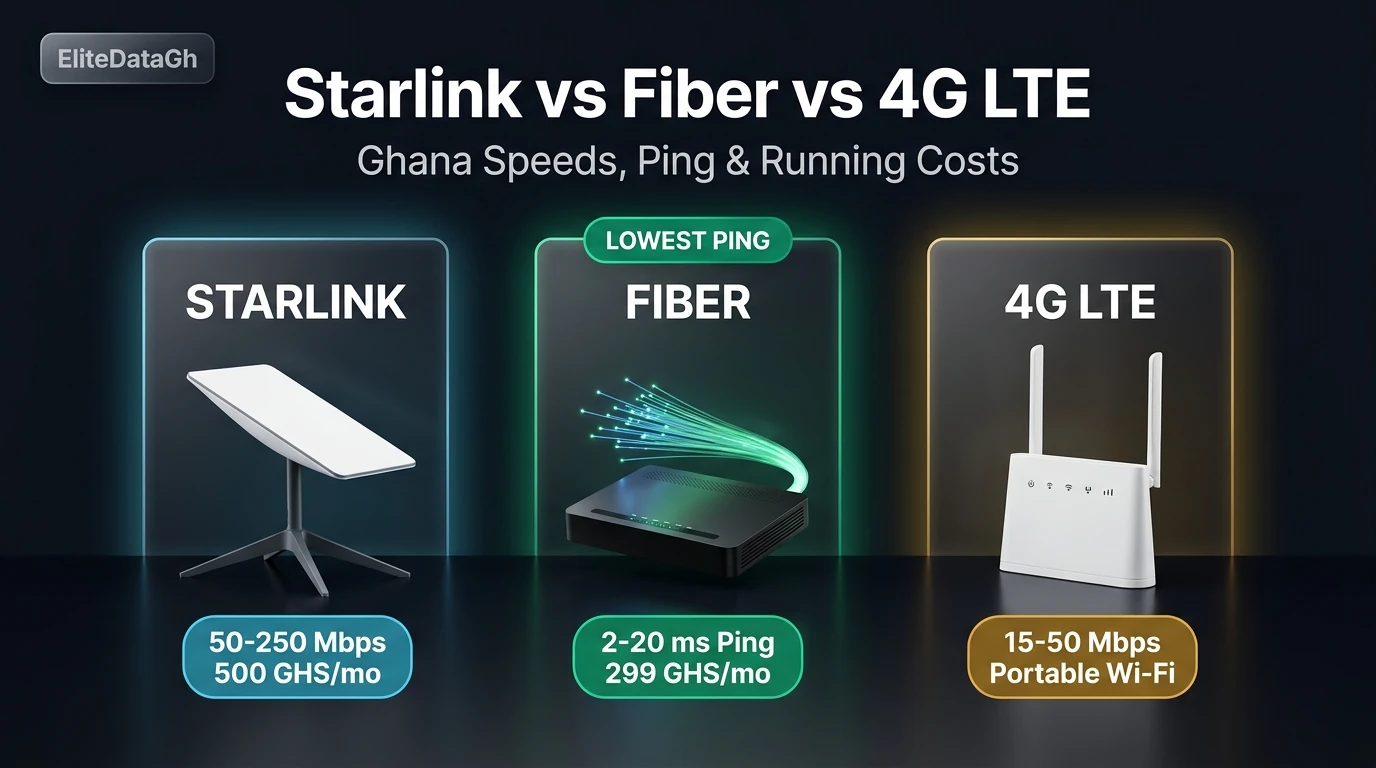
Table of Contents
If physical fiber optic cables already serve your street in Ghana, MTN Fibre Broadband or Telecel Fibre beats both Starlink and 4G LTE routers on ping latency (2 ms to 20 ms), annual running cost (starting near 3,838 GHS to 3,979 GHS for full Year-1 100 Mbps unlimited access on MTN), and upload stability. If you live outside cabled fiber neighborhoods, move across unpaved estates, or need high raw download throughput (50 Mbps to 250+ Mbps) anywhere with open sky, Starlink delivers unmatched coverage despite steep 4,200 GHS to 5,390 GHS hardware costs and 500 GHS to 770 GHS monthly bills. 4G LTE fixed-wireless routers remain viable primarily for renters moving frequently or lighter households unwilling to fund 4,000+ GHS upfront hardware.
Choosing the wrong connection wastes thousands of cedis every year. Heavy streaming households paying 516+ GHS monthly for high-volume 4G router data end up spending more per year than 300 Mbps fiber subscribers (444 GHS monthly on MTN) while suffering evening cellular tower slowdowns, whereas urban apartment dwellers buying Starlink over active fiber streets overpay by nearly 10,000 GHS in Year 1 for higher ping.
Head-to-Head Performance: Real Speeds, Ping Latency, and Coverage
Network physics determines real-world responsiveness more than headline marketing numbers. Light pulses traveling through buried glass fiber reach local servers almost instantaneously, Low Earth Orbit (LEO) satellites beam traffic roughly 550 km overhead to regional ground stations, and 4G LTE routers share radio spectrum with hundreds of phones connected to the same neighborhood mast.
| Metric | MTN Fibre Broadband | Telecel Fibre Broadband | Starlink (Standard / Mini) | 4G LTE Routers (Turbonet / Fixed Wireless) |
|---|---|---|---|---|
| Local Ping Latency | 2 ms to 15 ms (fastest) | 2 ms to 20 ms (fastest) | 40 ms to 60 ms (solid for LEO) | 25 ms to 60 ms (variable) |
| International Latency | 30 ms to 60 ms | 30 ms to 60 ms | 40 ms to 75+ ms (via regional PoP) | 70 ms to 120+ ms |
| Real Download Speeds | 100 Mbps to 500 Mbps by tier | Up to 300 Mbps where supported | 50 Mbps to 250+ Mbps (75+ Mbps typical) | 15 Mbps to 50 Mbps (drops in peaks) |
| Upload Performance | High / near-symmetric | High / near-symmetric | 15 Mbps to 35 Mbps | 5 Mbps to 20 Mbps |
| Data Policy | Speed tiers (299 to 999 GHS) with Fair Usage Policy | Volume tiers (80 GB to 1.05 TB) + Flexi Non-Expiry | Unlimited on Residential Lite and Unlimited | Volume-capped router bundles (4.3 GB to 350 GB+) |
| Portability | Fixed strictly to installed premises | Fixed strictly to installed premises | Relocatable (Roam plans or address transfer) | High (carry anywhere with 4G LTE signal) |
| Weather Sensitivity | Immune to rain and clouds | Immune to rain and clouds | Brief dropoffs in heavy tropical storms | Stable in light rain; sensitive to mast load |
| Geographic Reach | Limited cabled urban estates | Limited cabled urban estates | Nationwide (subject to Accra cell waitlists) | Wide across urban and peri-urban masts |
Notice how upload capacity separates real remote work from casual browsing. Software developers pushing large container images, video editors syncing cloud backups, and corporate offices hosting multi-stream cameras perform dramatically faster on fiber optics than on Starlink (15 Mbps to 35 Mbps upload) or 4G cellular links (5 Mbps to 20 Mbps).
Real 12-Month Running Costs in GHS (Hardware Plus Subscriptions)
Comparing only monthly bundle prices hides hardware lock-in and installation charges. Below is realistic Year-1 total cash outlay alongside recurring Year-2 costs using current verified Ghanaian pricing across carriers.
| Connection Choice | Upfront Hardware / Setup Cost | Monthly Service Plan | Estimated Year-1 Total (GHS) | Year-2 Annual Cost (GHS) |
|---|---|---|---|---|
MTN Fibre (100 Mbps Unlimited) | ~250 GHS to 350 GHS setup bundle (or 690 GHS Akwaaba Month-1 promo); ONT router stays MTN property | 299 GHS / month (300 Mbps at 444 GHS, 500 Mbps at 999 GHS) | ~3,838 GHS to 3,979 GHS | 3,588 GHS / year (100 Mbps) |
Telecel Fibre (Downloader ~290 GB / One Family Medium) | Connection and ONT router included inside initial onboarding package | 330 GHS (One Family Medium) or 410 GHS (Downloader ~290 GB) | 3,960 GHS to 4,920 GHS + setup fee | 3,960 GHS to 4,920 GHS / year |
| Starlink Standard + Residential Lite | 4,200 GHS to 5,390 GHS kit (Mini runs 2,100 to 4,500 GHS), zero Starlink install fee | 500 GHS / month | 10,200 GHS to 11,390 GHS | 6,000 GHS / year |
| Starlink Standard + Residential Unlimited | 4,200 GHS to 5,390 GHS kit (excluding shipping/custom roof mounts) | 770 GHS / month | 13,440 GHS to 14,630 GHS | 9,240 GHS / year |
MTN Turbonet 4G LTE (~95 GB light/medium) | ~1,200 GHS device bundle (with starter data) | ~253 GHS to 260 GHS / month | ~4,320 GHS | ~3,120 GHS / year |
MTN Turbonet 4G LTE (350 GB+ heavy use) | ~1,200 GHS device bundle | 516+ GHS / month | ~7,392+ GHS | ~6,192+ GHS / year |
Two Critical Budget Insights Revealed by Year-1 Math
- Starlink Versus Fiber Crossover Reality: MTN
100 Mbpsunlimited fiber costs roughly 3,979 GHS total across an entire first year (690 GHSpromotional Month-1 setup plus eleven299 GHSmonthly renewals). By contrast, buying a Standard Starlink kit (5,390 GHS) plus twelve months of Residential Unlimited (9,240 GHS) requires 14,630 GHS before roof mounts or backup power. Unless fiber does not exist on your street or suffers frequent neighborhood trench cuts, Starlink is never the cost-effective choice inside fiber zones. - The 4G Router Heavy-User Trap: Wireless 4G routers appear cheap at
1,200 GHShardware entry (*5057#for MTN broadband management), yet scaling past350 GBper month (516+ GHS) pushes annual 4G router bills higher than300 Mbpsunlimited MTN fiber (444 GHS/month) and higher than Starlink Residential Lite (500 GHS/month), all while delivering slower cellular download speeds.
Technical Trade-Offs Every Ghanaian Household Faces
Raw speed tests rarely mention four operational hazards that determine whether your connection survives real life across Accra, Kumasi, Takoradi, or Tamale.
1. Physical Fiber Trench Cuts vs Satellite Continuity
Road expansion, storm drain excavation, and utility digging periodically sever underground fiber lines in rapidly developing suburbs, sometimes leaving affected streets offline for 24 to 72 hours while splicing crews locate breaks. Starlink bypasses street trench vulnerability completely because signals drop directly from overhead satellites, making it popular either as primary connectivity outside core city centers or as business backup alongside fiber.
2. Fair Usage Policy (FUP) vs Hard Data Caps
MTN Fibre packages operate on unlimited speed tiers (100 Mbps, 300 Mbps, 500 Mbps via *5057#) governed by a Fair Usage Policy (FUP) that restricts abusive server hosting or continuous peer seeding to protect neighbors on shared splitters. Telecel Fibre (*900# or Telecel Play) instead enforces clear monthly volume buckets (26 GB Browser up to 621 GB Office or 1.05 TB One Family, plus non-expiry Flexi options from 100 GHS). Light families downloading under 100 GB monthly can thrive affordably on Telecel capped plans, while four-person video-heavy homes frequently burn past 300 GB mid-month and prefer speed-tiered unlimited plans or Starlink.
3. Dumsor Backup Power Requirements
During electricity outages, power draw decides how long your battery inverter survives:
- Fiber ONT Router and 4G LTE Router: Typically pull only 10W to 18W (
12V DC), running easily for 8 to 15 hours on a compact mini DC UPS router backup battery costing a fraction of a full inverter. - Starlink Standard Gen 3: Pulls 45W to 75W average (
100W+boot surge), draining small home power banks three to five times faster than a fiber ONT unless paired with a500Wh+lithium power station or Starlink Mini (25W to 40Wvia100WUSB-C Power Delivery).
4. Dedicated Wireless Alternatives and Portability
Renters moving apartments twice a year face stiff friction transferring fixed fiber ports between compounds. Portable cellular routers such as MTN Turbonet, plus regional 4G wireless operators documented across our network hubs including Surfline Ghana, Busy Internet Ghana, and Telesol Ghana, plug into any wall socket within minutes of relocating. Subscribers buying Starlink specifically to bypass Greater Accra residential waitlists should also note that Residential plans tie to fixed address cells unless upgrading to Roam tiers or formally updating address coordinates inside the portal. Check our complete Starlink Ghana Hub alongside MTN Ghana and Telecel Ghana guides for network-specific troubleshooting, and verify operator USSD menus via our Ghana USSD Shortcodes Directory.
Which Connection Matches Your Situation?
- Choose MTN Fibre (
*5057#) or Telecel Fibre (*900#) if physical fiber cabling terminates inside your compound, you care about competitive online gaming or cloud video uploads (2 ms to 20 msping), or you want unlimited100 Mbps+speed under 4,000 GHS across your entire first year. - Choose Starlink (
StandardorMini) if fiber cables have not reached your estate, you run a remote studio, lodge, farm, or regional office needing50 Mbps to 250+ Mbpsdownloads, or you want sky-based redundancy independent of street roadwork cuts. - Choose a 4G LTE Router if you rent short-term housing without permanent mounting permissions, commute regularly between towns, consume under
100 GBper month, and need a10WDC-UPS-friendly device that stays online effortlessly during extended outages.
Frequently Asked Questions About Home Internet in Ghana
Is Starlink faster than MTN and Telecel Fiber in Ghana?
For raw downloads, Starlink (50 Mbps to 250+ Mbps) beats entry-level 100 Mbps fiber during uncongested hours, though top 300 Mbps to 500 Mbps MTN and Telecel fiber tiers remain faster overall. For responsiveness (ping latency) and heavy file uploads, buried fiber (2 ms to 20 ms ping) consistently outperforms Starlink (40 ms to 60 ms).
Which home internet option has the lowest monthly running cost in Ghana?
On a strict cost-per-gigabyte unlimited basis, MTN 100 Mbps Fibre at 299 GHS per month delivers the lowest cost for heavy households, followed by Telecel capped residential packages (120 GHS to 330 GHS monthly for moderate usage) and Starlink Residential Lite at 500 GHS per month.
Why do 4G LTE routers slow down at night in Accra and Kumasi?
4G LTE routers share radio channels on the nearest cell tower with every smartphone subscriber in range. Between 7:00 PM and 10:30 PM, simultaneous video streaming across local phones saturates sector bandwidth, cutting fixed-wireless router speeds down significantly compared to wired fiber.
Can I keep Starlink running during dumsor outages without an inverter?
Yes, though standard hardware requires substantial battery capacity (45W to 75W average, spiking past 100W at startup). Running a Starlink Mini (25W to 40W) off a 100W (20V / 5A) USB-C PD power bank, or pairing a Standard kit with a 500Wh to 1,000Wh lithium power station, avoids noisy generators during blackouts.
Keep Reading
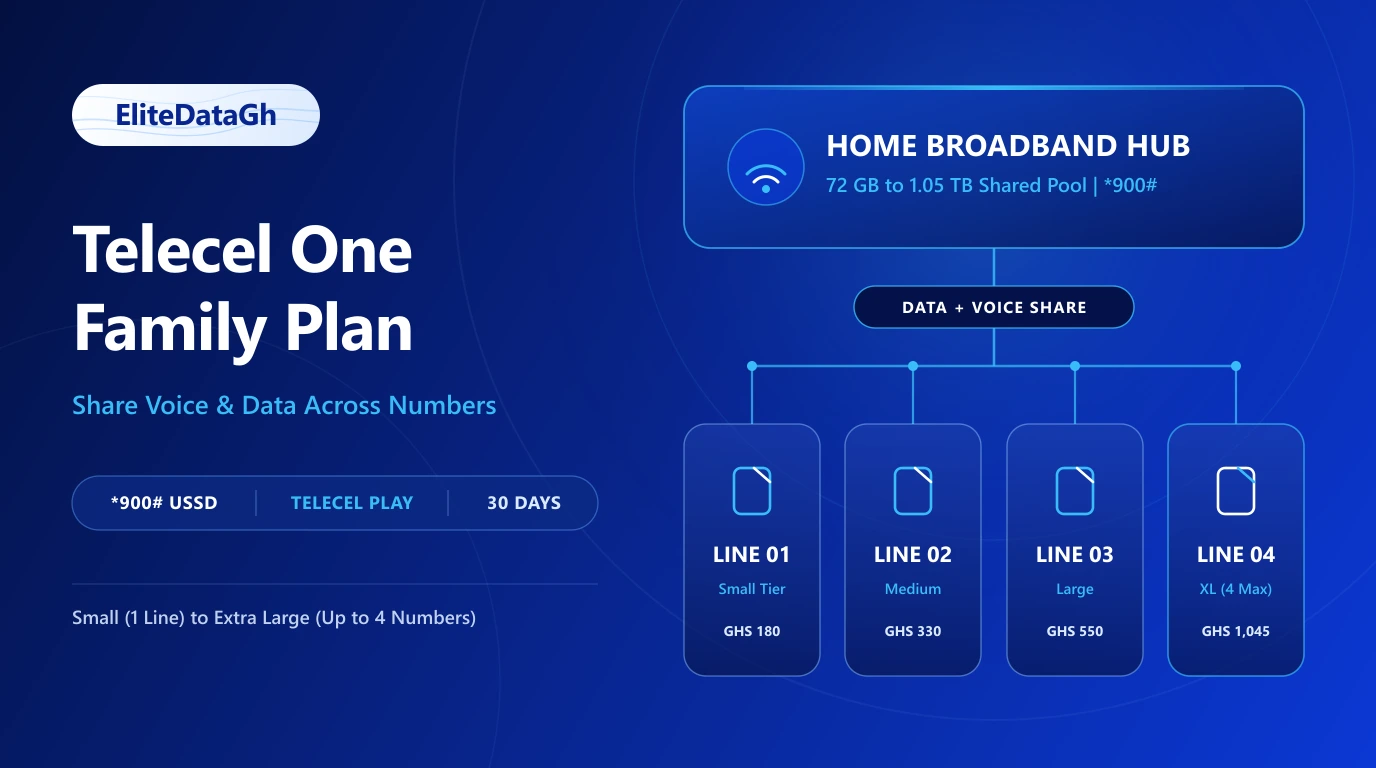
Telecel One Family Plan Explained: How to Share Voice and Data Across Numbers
Telecel One Family explained: dial *900# or use Telecel Play to share broadband data and voice across 1 to 4 paired numbers on 30-day household plans cleanly.
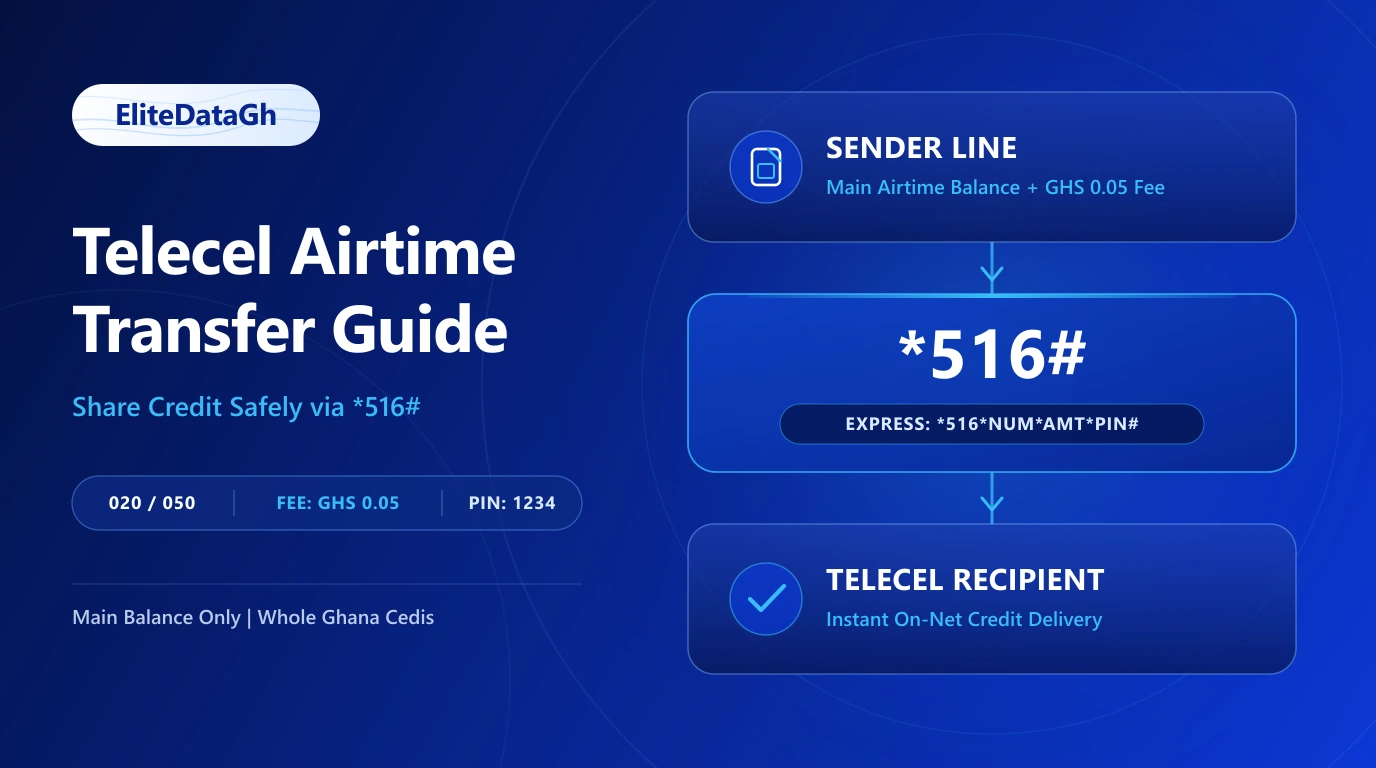
How to Share or Transfer Airtime on Telecel Ghana Using *516#
Dial *516# on Telecel Ghana to share airtime credit to 020 and 050 numbers. Learn the express code, GHS 0.05 fee, default 1234 PIN setup, and transfer rules.
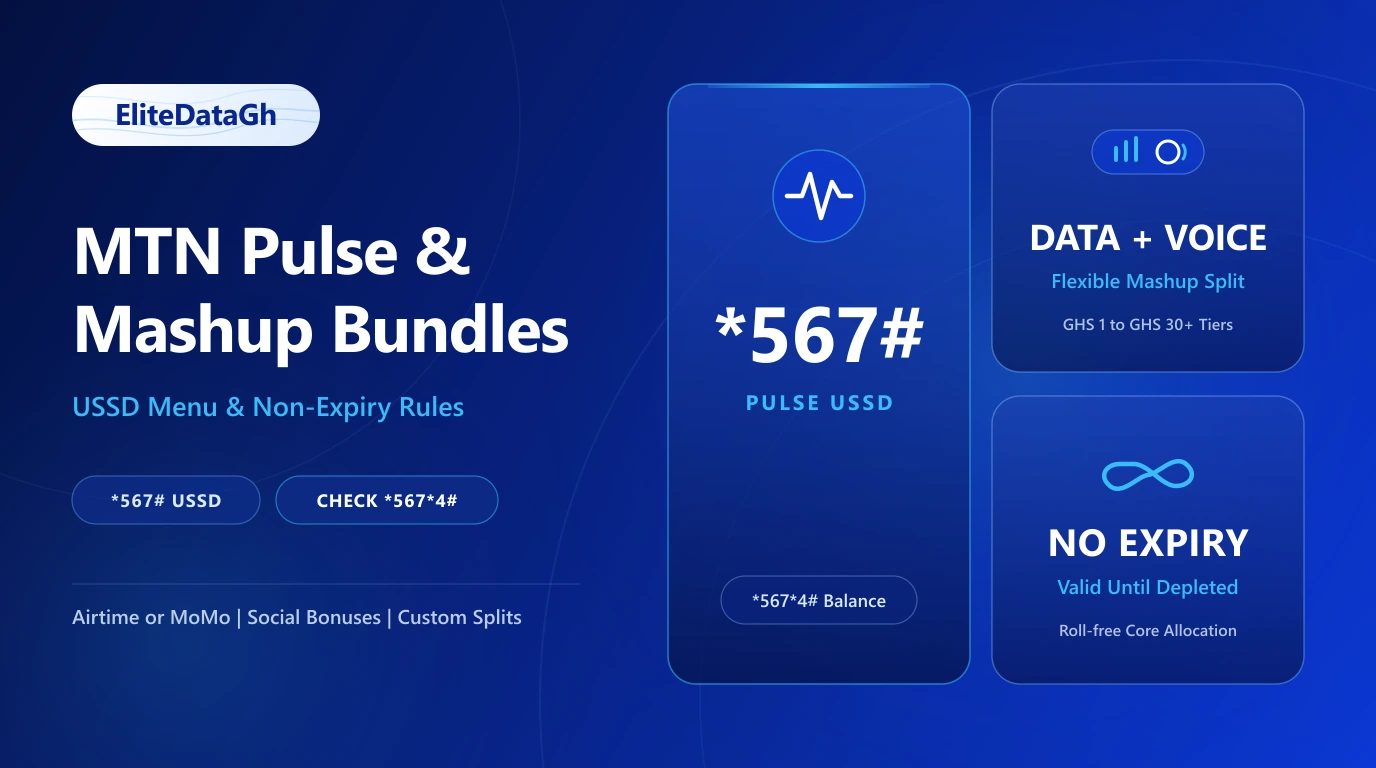
MTN Pulse and Mashup Bundles (*567#): Complete USSD Guide and Validity Rules
Dial *567# for MTN Pulse Mashup bundles in Ghana. Explore Voice and Data mix rules, social bonuses, non-expiry validity, and *567*4# balance checks cleanly.
MTN Ghana Data Zone (*138#) Explained: Why Offers Disappear and How to Qualify
Learn why MTN Ghana Data Zone (*135# and *138#) and Just4U (*141#) offers change, how NCA SMP rules affect pricing, and how your SIM qualifies for better data.
How to Cancel Unwanted Subscriptions and Caller Tunes Draining MTN Airtime
Cancel unwanted MTN Ghana subscriptions draining your airtime: dial *175# for VAS promos, *1355# or SMS Unsubscribe to 1355 for Caller Tunez, and STOP to 138.
How to Check Your SSNIT Number, Statements, and Pay Contributions via USSD (*711*9#)
Dial *711*9# on MTN, Telecel, or AT to verify your SSNIT number, merge your Ghana Card, email contribution statements, and pay SEED MoMo contributions.
Complete Guide to Ghana Emergency Shortcodes: Police (191), Fire (192), Ambulance (193), and 112
Dial 112 toll-free in Ghana for unified Police (191), Fire (192), and Ambulance (193) dispatch, plus verified NADMO, DOVVSU, ECG, and 292 cyber hotlines.